
FAQs regarding various treatments
Click on any topic below to view specific questions and answers.
FAQs regarding Braces and aligners
An orthodontist is a dental specialist trained to correct teeth and jaw alignment issues.
Treatment is advised when misalignment affects function, appearance, or oral health.
Treatment duration varies but typically ranges from 12 to 24 months.
Some discomfort is normal initially but usually subsides within a few days.
Yes, orthodontic treatment is effective for adults at any age.
Traditional braces use metal or ceramic brackets fixed to your teeth to move them. Clear aligners are custom-made, nearly invisible plastic trays that you can remove to eat and brush. Both achieve excellent results, but aligners offer more flexibility and look completely natural.
Not necessarily. Teeth extraction is only recommended if there is severe crowding or if we need to create space to pull protruding teeth back safely. Modern orthodontic techniques allow us to treat many patients without removing any permanent teeth.
For traditional braces, you will usually need a quick 15-minute appointment every 4 to 6 weeks for adjustments. If you choose clear aligners, your visits are often further apart—typically every 6 to 10 weeks—just to monitor your progress and hand over your next sets of trays.
With traditional braces, you need to avoid extremely hard, crunchy, or sticky foods (like hard nuts, sticky candy, or biting directly into a whole apple) because they can break the brackets. With clear aligners, you simply take the trays out before meals, meaning you can eat whatever you like.
Teeth have a natural memory and want to drift back to their old positions over time. To lock your new smile in place permanently, we provide custom “retainers” (either a tiny wire hidden behind your teeth or a clear night-time tray) once your active treatment is done.
he total investment for aligning your teeth varies based on the complexity of your case and the type of material you choose.
To give you a general idea of the dental treatment cost in rajapalayam, minor interceptive appliances or post-treatment retainers (like a Hawley’s appliance) can start from around ₹5,000. For comprehensive, full-mouth orthodontic corrections—such as traditional metal braces, aesthetic ceramic clips, or advanced invisible aligners—the investment is higher and is custom-calculated for your specific smile and may roughly start from around ₹20,000.
At Elegance, we provide an absolute, all-inclusive pricing breakdown during your consultation with no hidden fees, and we offer flexible interest-free monthly installment options to make your treatment comfortably budget-friendly.
FAQs regarding RootCanal Treatment
Inside every tooth is a soft tissue called the pulp, which contains nerves and blood vessels. When deep decay or trauma allows bacteria to infect this area, it causes severe pain or an abscess. A root canal treatment simply involves removing the damaged pulp, thoroughly cleaning and disinfecting the empty canals inside the root, and sealing them to prevent future infection. It is essentially a deep cleaning for the inside of your tooth.
This is the most common fear, but the reality is that a root canal relieves pain rather than causing it. The procedure is performed under local anesthesia, meaning the tooth and the surrounding area are completely numbed. You might feel some pressure during the treatment, but it should not feel any different than getting a standard dental filling.
While only an X-ray can confirm it, common warning signs include:
- Continuous, throbbing toothaches that keep you awake at night.
- Severe lingering pain when you drink hot or cold liquids.
- Pain or sharp discomfort when biting down or chewing.
- Swelling or tenderness in the gums near the painful tooth.
No. Antibiotics can travel through your bloodstream to temporarily reduce the swelling and bacteria around the tooth, but they cannot reach the source of the infection inside the dead tissue within the root canals. The only way to truly fix the issue is to physically clean out the infected spaces. Ignoring it will eventually cause the infection to spread to the jawbone.
Saving your natural tooth is always the best clinical option. Pulling a tooth leaves a gap that causes your neighboring teeth to shift over time, which messes up your bite alignment and makes chewing difficult. Replacing a missing tooth later with a bridge or an implant requires more time, structure, and expense than saving your own tooth with a root canal.
Thanks to modern endodontic technology, many root canals can be safely completed in a single sitting of about 45 to 60 minutes. However, if the infection is severe or there is a lot of swelling, we may place a temporary medication inside the tooth and have you return for a second visit a few days later to ensure it is completely sterile before final sealing.
In almost all cases for back teeth (molars and premolars), yes. Once the nerve and blood supply are removed, the tooth loses its moisture source and becomes brittle over time. Because back teeth bear the heavy pressure of chewing, an unprotected root-canaled tooth can easily crack or split. A custom dental crown acts like a protective helmet, reinforcing the tooth so you can chew normally.
As the anesthesia wears off, it is completely normal to experience mild soreness or a “bruised” sensation around the tooth for 2 to 3 days, especially when chewing. This is just your body’s natural healing response in the surrounding tissues. It is easily managed with standard over-the-counter pain relievers that we will prescribe for you.
That highly depends on the severity of the spread of caries and the condition of the teeth before beginning the rootcanal treatment and the maintenance afterwards. but in a ideal scenario ,With a high-quality dental crown and good oral hygiene, a tooth that has undergone a root canal can last a lifetime. The tooth no longer has a live nerve, but it is still held securely in place by your jawbone and healthy gums.
Yes. While the inside of the tooth can no longer feel pain or develop an infection, the outside structure near the gumline is still made of natural tooth material. If brushing and flossing are neglected, plaque can still cause decay around the edges of your new crown. Regular checkups and good cleaning habits are still essential.
A Root Canal Treatment (RCT) is a highly specialized procedure designed to save a severely decayed, infected, or painful tooth from extraction.
When looking at the standard dental treatment cost in rajapalayam, an RCT typically ranges from ₹2,000 to ₹5,000 depending entirely on the severity of the infection and the position of the tooth (front teeth are generally simpler to treat, while back molars have more root canals). However, for most routine or standard single/double-sitting cases, the cost is usually around ₹2,500.
Please note: This investment specifically covers the cleaning, disinfecting, and sealing of the infected root canals. If the tooth requires a protective dental crown or cap afterward to restore its full biting strength, that material (such as ceramic or Zirconia) is calculated as a separate option based on your preference. At Elegance, we take quick digital X-rays during your consultation to give you an exact, transparent quote before any procedure begins.”
FAQs regarding Crown & Bridge
A crown (often called a cap) is a custom-made cover that fits entirely over a single damaged, cracked, or root-canaled tooth to restore its strength, shape, and size. A bridge, on the other hand, is used to replace one or more completely missing teeth. It consists of a false tooth held firmly in place by crowns cemented onto the healthy teeth on either side of the gap.
Clinical studies show that teeth lose their internal moisture and become brittle after a root canal because the blood supply is removed. For back teeth, which bear the heavy mechanical forces of chewing, an unprotected tooth is at a significantly higher risk of a vertical fracture. A custom crown acts like a protective helmet, distributing chewing pressure evenly and preventing the tooth from splitting apart.
On average, a well-fabricated crown or bridge lasts between 10 to 15 years. However, clinical data shows that with excellent oral hygiene and regular dental checkups, they can easily last 20+ years. Their lifespan depends heavily on the health of the underlying tooth and gums, rather than the material wearing out.
Modern dental ceramics allow us to match the exact shade, translucency, and texture of your natural teeth. We primarily use metal-free materials like Zirconia and E-max (lithium disilicate). These premium materials do not cause the unsightly black metallic line at the gumline over time, which was common with older porcelain-fused-to-metal (PFM) crowns.
Yes. To make room for the crown to fit over your tooth without making it look bulky or altering your bite, we must carefully reduce the outer enamel layer by roughly 1 to 2 millimeters. This process is done with extreme precision under local anesthesia to ensure a smooth, flush boundary between the crown and your natural gum line.
The preparation phase is entirely painless because the tooth and surrounding gums are deeply numbed using local anesthesia. After the numbness wears off, and while you wear a temporary acrylic crown between visits, you might experience mild, temporary sensitivity to hot or cold liquids. This is completely normal and settles once the permanent crown is securely bonded in place.
Both are excellent, but they have different clinical indications:
- A Dental Implant is widely considered the gold standard because it replaces the root in the jawbone directly, meaning we don’t have to touch or alter the adjacent healthy teeth.
- A Dental Bridge is a faster, non-surgical solution that is highly effective, especially if the neighboring teeth are already heavily filled or require crowns anyway.
While a crown can be brushed and flossed normally, a bridge requires slightly more care. Because the replacement tooth (the pontic) sits just above the gum line without a root, food debris and plaque can accumulate underneath it. We instruct our patients on how to use a special, flexible threader (Superfloss) or a water flosser to easily flush out particles from beneath the bridge daily.
Yes. Even though the crown itself is completely immune to decay, the natural tooth structure hidden underneath it at the gum line is still vulnerable. If plaque builds up at the margin where the crown meets the tooth, a cavity can form underneath. This is why thorough brushing at the gum line remains vital.
If a crown comes loose, it is usually because the dental cement has degraded over time or a sticky food item pulled it up. Do not attempt to superglue it back yourself, as this can permanently damage the underlying tooth structure. Keep the crown clean, store it safely in a small container, and call the clinic desk right away. In most cases, if the underlying tooth is completely intact, we can clean and re-cement it for you in a few minutes.
A dental crown (or tooth cap) is used to protect a single weakened or root-canal-treated tooth, while a dental bridge is a fixed option used to replace one or more missing teeth by connecting multiple units together.
To give you an idea of the dental treatment cost in rajapalayam, a standard protective dental crown option can start from as low as ₹1,500 for a single tooth.
However, we provide a wide variety of tailored treatment plans depending entirely on your functional and aesthetic preferences. The final investment varies based on key premium factors, including:
- The Material Choice: Options range from traditional porcelain-fused-to-metal (PFM) to highly aesthetic, metal-free CAD/CAM ceramics and premium, life-like Zirconia.
- Technology & Processing: Advanced treatments utilizing precise digital 3D intraoral scanning and automated milling offer superior fit and longevity compared to traditional manual impressions.
- Laboratory Tier: The specific dental laboratory and the warranty tier (ranging from basic processing to international multi-year guarantees) also play a role in the plan you select.
At Elegance, we walk you through physical material samples during your consultation so you can pick the exact plan that fits your budget and smile goals.
FAQs regarding Dental Implant prosthesis
A dental implant is a permanent, medical-grade replacement for a missing tooth root. It consists of three primary components engineered to mimic natural tooth structure:
- The Fixture (Screw): A tiny cylinder placed securely into your jawbone.
- The Abutment: A precise connector piece that sits on top of the screw.
- The Crown: The custom ceramic tooth visible in your mouth that handles the actual chewing.
Long-term multi-center clinical studies show that dental implants have the highest success rate of any joint or tissue replacement therapy in the human body—consistently averaging between 95% and 98%. When proper surgical protocols and patient oral hygiene are maintained, the vast majority of implants function perfectly for decades without issue.
While it sounds intimidating, patients routinely report that getting an implant involves far less discomfort than a standard tooth extraction. The procedure is performed under deep local anesthesia, meaning the site is completely numb. Furthermore, jawbone tissue contains very few pain-sensing nerve endings compared to a live tooth pulp. Most post-operative tenderness is confined to the surrounding gum tissue and is easily managed with routine anti-inflammatory medication for 2 to 3 days.
Unlike a bridge which can be placed in a week, implants rely on a biological process called osseointegration. Over a period of 3 to 6 months, your natural jawbone cells literally grow around and tightly fuse to the microscopic ridges of the titanium fixture. This creates a rock-solid, organic bond capable of anchoring a tooth. Rushing this healing window dramatically increases the risk of implant failure.
True medical rejection (like an organ transplant rejection) does not occur with dental implants. Implants are made of commercially pure titanium, which is highly biocompatible. The human body does not recognize it as a foreign threat, allowing bone to fuse directly to it. When an implant fails, it is almost always due to localized factors—such as an early bacterial infection, poor bone density, or tobacco use disrupting blood flow—not an allergic rejection.
When a tooth is removed, the surrounding jawbone no longer receives mechanical stimulation from chewing and naturally begins to shrink over time. If a tooth has been missing for several years, there might not be enough bone thickness left to completely cover the implant screw. A bone graft is a straightforward clinical procedure where we place a specialized mineral matrix into the area to encourage your body to rebuild its own natural bone volume, ensuring a safe and sturdy foundation.
A dental bridge requires us to significantly shave down the healthy enamel of the two adjacent teeth just to hold the missing tooth in place. If those anchor teeth ever fail or develop decay, the entire bridge fails. A dental implant is completely standalone—it leaves your neighboring teeth completely untouched. Additionally, an implant is the only option that keeps your jawbone active and prevents the bone loss that naturally follows tooth loss.
Yes, but the risk profile is different. Clinical data demonstrates that nicotine constricts blood vessels, which significantly restricts the supply of oxygen and essential healing cells to the surgical site. This delays osseointegration and elevates the failure rate to roughly 10% compared to non-smokers. We strongly advise patients to completely halt smoking for at least two weeks before and several weeks after surgery to ensure predictable healing.
Because the entire assembly is made of synthetic materials (titanium and porcelain), an implant can never get a dental cavity. However, the living gum tissue and bone surrounding the implant can still become infected if oral hygiene is neglected. This condition is called peri-implantitis. If plaque bacteria collect at the gumline, it can cause gum inflammation and eventually dissolve the supporting bone holding the implant in place.
You clean a dental implant almost exactly like a natural tooth: thorough brushing twice a day and regular daily flossing. Because the seal between an implant and your gums is slightly different than a natural tooth, we often recommend using a water flosser (interdental cleaner) to easily flush out hidden debris. Routine professional scaling visits every six months at our clinic ensure the surrounding tissue stays perfectly healthy for a lifetime of use.
A dental implant is the absolute gold standard for replacing a missing tooth. Unlike traditional bridges, an implant acts like a permanent, artificial tooth root placed directly into the jawbone, meaning it looks, feels, and functions exactly like a natural tooth without altering neighboring teeth.
When exploring this specialized dental treatment cost in rajapalayam, the baseline investment for a single-tooth dental implant can start around ₹15,000. However, for a complete, long-lasting restoration, the ideal and realistic cost is typically higher—usually averaging around ₹20,000 or more per unit.
This price difference depends entirely on critical clinical and material factors, such as:
- Implant Brand & Material: Utilizing internationally recognized, premium titanium implant systems that come with lifetime manufacturer warranties and superior success rates.
- The Abutment & Final Crown: The type of high-strength, aesthetic component (like custom screw-retained Zirconia or metal-free ceramic) fixed on top of the implant to complete your smile.
- Bone Health & Density: Whether your jawbone requires any minor, supportive treatments (like bone grafting) to create a highly stable foundation for the implant.
Because every individual’s bone anatomy is completely unique, we conduct a thorough clinical examination and review precise imaging at Elegance to give you an exact, upfront breakdown for your specific case
FAQs regarding Scaling, Polishing and Teeth whitening
Brushing and flossing remove plaque—a soft, sticky film of bacteria that forms daily. However, if plaque isn’t perfectly cleaned off within 24 to 48 hours, it absorbs minerals from your saliva and hardens into calculus (tartar). Tartar is essentially a layer of calcified bacterial rock that is cemented to your teeth. It cannot be brushed or scraped off at home; it requires a dental professional using specialized ultrasonic scaling instruments to safely vibrate it loose.
This is the most common dental myth, and the clinical reality is exactly the opposite. The ultrasonic tips we use do not cut or shave your enamel; they use high-frequency sound vibrations and water to gently shatter the brittle tartar buildup.
- If you feel “gaps” or “looseness” after scaling, it is because a thick wall of tartar was physically blocking the spaces between your teeth and falsely binding them together while causing your gums to recede underneath.
- Removing that destructive tartar allows your gums to finally breathe, stop bleeding, and heal.
For a patient with healthy gums and great home hygiene habits, a professional cleaning every 6 months is the evidence-based standard. However, if you are naturally prone to rapid tartar formation, have a history of gum disease (periodontitis), or are undergoing active orthodontic treatment with braces, we may recommend a maintenance visit every 3 to 4 months to protect your bone and gum levels.
Polishing is the final step immediately following scaling. Scaling leaves the microscopic surfaces of your teeth slightly raw and textured. We use a specialized prophy paste and a soft, spinning rubber cup to buff your teeth completely smooth. This smoothness serves a dual purpose: it removes superficial external stains (from coffee, tea, or food colors) and makes it much harder for new plaque bacteria to stick to your teeth.
No, they are completely different procedures with different goals:
- Scaling and Polishing is a preventive health treatment. It removes external debris, tartar, and surface stains, revealing your natural tooth color. It does not alter the actual shade of your teeth.
- Teeth Whitening (Bleaching) is a cosmetic treatment. It uses safe, peroxide-based active gels that penetrate into your enamel to break down internal pigment molecules, shifting your teeth several shades lighter than your natural baseline.
Yes. Clinical data proves that professional whitening, when monitored by a dentist, does not damage or erode your enamel structure. The whitening gel safely penetrates the micro-pores of your enamel to oxidize internal stains without altering the hard mineral density of the tooth.
Temporary tooth sensitivity is the most common side effect of whitening, affecting roughly half of all patients. The bleaching gel temporarily dehydrates the teeth and opens up the microscopic tubules leading to the internal nerve. This is entirely reversible and typically subsides completely within 24 to 48 hours. We use advanced desensitizing agents before and after the session to minimize this discomfort.
No. Whitening agents only react with natural, organic tooth structures. They will not change the color of dental ceramic, composite resin fillings, porcelain veneers, or acrylic. If you have a prominent filling or crown on a front tooth, it will stay its original color while the surrounding natural teeth brighten. If you plan on getting cosmetic work or crowns done, we always recommend whitening your teeth first so we can match the new ceramic to your brightened smile
Depending on your lifestyle, professional whitening results generally last anywhere from 6 months to 2 years. The longevity depends almost entirely on your dietary habits. Frequent consumption of highly pigmented substances like black tea, filter coffee, red wine, turmeric-heavy foods, or smoking will restain the pores of your teeth much faster.
From a clinical standpoint, we advise extreme caution. Many over-the-counter “whitening” toothpastes, especially charcoal-based ones, are highly abrasive. They do not actually whiten the inside of your teeth; instead, they scrape away surface stains by literally scrubbing off a microscopic layer of your protective enamel. Over time, this thinning of enamel exposes the yellow dentin underneath, making your teeth look more yellow and causing chronic sensitivity. Stick to clinically approved, non-abrasive methods.
Maintaining a bright, healthy smile involves both routine preventive care and specialized cosmetic treatments.
When looking at the standard preventive dental treatment cost in rajapalayam, professional scaling—which uses gentle ultrasonic vibrations to deep-clean hardened tartar and plaque from your teeth—typically ranges from ₹700 to ₹1,000 depending on the severity of the buildup. To complete the cleaning, a professional stain-removal teeth polishing session is available for ₹300, which leaves the surface of your enamel perfectly smooth so new food debris or plaque cannot easily stick to it.
For individuals looking to dramatically brighten their smile, the cost of cosmetic teeth whitening (dental bleaching) depends entirely on the severity of the existing surface stains and whether you require a rapid, highly effective in-office light-activated treatment or a gradual, custom-molded home whitening kit.
At Elegance, we evaluate your current tooth shade during a quick checkup and provide a clear, upfront quote for the exact cleaning or whitening plan that matches your goals.
FAQs regarding Veneers and Smile Designing
An ultra-thin shell of medical-grade ceramic or composite resin permanently bonded to the front of a tooth. Think of it like a durable, natural-looking artificial fingernail that instantly hides chips, permanent stains, or minor gaps.
A modern 3D planning protocol where we map out your ideal smile using digital photos and intraoral scans before any treatment begins. We can even place a temporary “Trial Smile” mock-up in your mouth so you can preview the exact final look in the mirror first.
Porcelain Veneers: Custom-crafted in a dental lab, look completely natural, resist stains entirely, and last 10 to 15+ years.
Composite Veneers: Sculpted directly on your teeth in a single visit. They are more economical but can chip or stain over time, typically lasting 5 to 7 years.
No. Modern porcelain veneers require removing only a micro-layer of enamel—roughly 0.3 to 0.5 mm, which is about the thickness of a contact lens. This minor step simply ensures the veneer sits completely flush and looks natural at the gumline.
For minor overlapping or small gaps, yes (often called “instant orthodontics”). However, for severe crowding or bite alignment issues, we recommend using braces or clear aligners first to move the roots safely before making cosmetic enhancements.
Traditional porcelain veneers are irreversible. Because a microscopic layer of enamel must be adjusted to fit them, those teeth will always require a veneer or a crown to remain protected and functional for life.
No. High-quality dental porcelain is a non-porous, glass-like material that completely resists pigment absorption. You can enjoy filter coffee, tea, and traditional foods without worrying about your veneers changing color.
Not at all. The preparation phase is done under local anesthesia so you won’t feel a thing. You might experience minor, temporary sensitivity to cold foods while wearing your temporary acrylic veneers, but it vanishes once the final porcelain is bonded.
You can eat completely normally, but you must avoid using your front teeth as physical tools to bite ice, hard candy, or open packaging. Aside from that, regular brushing, daily flossing, and your standard six-month checkup are all that is required.
Yes. The veneer only covers the visible front surface. The back, edges, and margins of your natural tooth are still vulnerable to plaque. Thorough brushing at the gumline and daily flossing are essential to prevent cavities underneath.
Dental veneers are ultra-thin, custom-crafted shells of tooth-colored materials permanently bonded to the front surface of your teeth. They are the ultimate cosmetic solution to instantly correct chipped teeth, close wide gaps, mask severe internal staining, or realign slightly crooked teeth for a flawless smile.
When looking at premium aesthetic options within the dental treatment cost in rajapalayam, high-quality dental veneers typically start from ₹10,000 per tooth.
The final investment for a smile transformation depends on the material selected and the level of personalization required:
- The Material Grade: While direct composite veneers are a quicker baseline option, premium porcelain or ultra-thin E-max ceramic veneers offer unmatched translucency, complete stain resistance, and a lifelike appearance that mimics natural enamel.
- Digital Smile Design: Designing a perfectly balanced smile involves custom facial mapping, specific shade-matching protocols, and advanced laboratory artistry to ensure the veneers perfectly complement your features.
- Durability and Longevity: Premium ceramic veneers are an investment that can comfortably last 10 to 15 years or more with proper routine care.
At Elegance, we provide a detailed aesthetic consultation where we analyze your smile profile and provide a completely customized quote tailored to your cosmetic goals.
FAQs regarding Extraction / Impaction Surgery
Simple Extraction: Performed on a tooth that is fully visible above the gumline. It is gently loosened and removed using routine dental instruments.
Surgical Extraction: Required if a tooth has broken off at the gumline or remains trapped beneath the bone, requiring a tiny, precise incision to safely access and remove it.
A tooth is considered impacted when it is blocked from fully growing into its correct position. This usually happens because it is physically obstructed by an adjacent tooth, dense jawbone, or thick gum tissue. It most commonly occurs with wisdom teeth and upper canines.
No, definitely not. Depending on the tooth’s position, purpose, and your age, we have three distinct clinical pathways: orthodontic correction to save the tooth, a supervised “wait and watch” approach, or extraction if it is actively causing damage.
If a functionally critical tooth (like an upper canine) is trapped in the bone, an orthodontist can surgically expose a tiny portion of it, bond a specialized bracket, and use gentle braces or clear aligner forces to slowly guide it down into its proper space in your smile line.
If an impacted tooth is deeply embedded in the bone, completely asymptomatic (no pain, swelling, or infection), and not pressing against neighboring roots, we can leave it alone. However, it requires regular clinical monitoring and a panoramic X-ray (OPG) every one to two years to ensure no silent cysts or damage develop over time
Evolutionary changes have caused modern human jaws to become slightly smaller over generations, while the size of our teeth hasn’t fully scaled down. There is frequently simply not enough physical real estate at the back of the jaw for the final four wisdom teeth to emerge normally.
Not at all. The entire procedure is performed under profound local anesthesia, meaning the tooth and surrounding tissues are completely numbed. You will feel zero sharp pain. You will only feel a dull sensation of pressure or pushing as the tooth is gently loosened, which is entirely normal.
Protecting the blood clot that forms in the empty socket is vital for proper healing. You must strictly avoid spitting forcefully, smoking, drinking through a straw, or consuming hot liquids for the first 48 hours. The negative pressure or heat can dislodge the clot and delay healing.
A dry socket occurs if the protective blood clot dissolves or gets dislodged prematurely, exposing the underlying bone and nerves to air and food. It causes a dull, throbbing ache three to four days after the procedure. It is easily resolved with a quick visit to the clinic, where we place a soothing, medicated dressing to stop the discomfort instantly.
Unless it was a wisdom tooth being removed, an empty space should eventually be filled. Leaving a gap causes neighboring teeth to naturally tilt and shift into the open area, which can ruin your bite alignment. Replacing it with a standalone dental implant or a bridge keeps your smile perfectly locked in place.
The investment varies widely depending on the position of the tooth and the complexity of the case. For a single tooth, treatment typically starts from ₹400 for a straightforward, simple extraction and can range up to ₹3,500 for advanced surgical or impacted wisdom tooth cases. We always provide a clear, transparent estimate after evaluating your digital X-ray.
FAQs regarding Dentures
RPD (Removable Partial Denture): Used when you still have some healthy natural teeth left. It features a lightweight framework that clips securely onto your remaining teeth to fill the gaps.
CD (Complete Denture): A full set of artificial teeth used when an entire upper or lower arch of teeth is completely missing.
It typically takes about 2 to 4 weeks for your tongue, cheeks, and jaw muscles to adapt. Speaking clearly and chewing might feel a bit awkward initially, and your mouth may temporarily produce more saliva, which is completely normal.
No, you should strictly remove them before going to bed. Taking your dentures out gives your gum tissues and jawbone a chance to rest, prevents bone shrinkage, and drastically reduces the risk of oral fungal infections.
Brush your dentures daily with a soft-bristled brush and mild soap or denture cleaning paste (never use harsh regular toothpaste). Always rinse them over a towel or basin of water so they don’t break if dropped, and store them in plain water overnight so they don’t warp.
Your jawbone naturally shrinks and remodels over time in areas where teeth are missing. Because the bone changes shape but the hard denture does not, it will eventually lose its tight fit. If your denture clicks, slips, or causes sores, bring it to the clinic for a quick reline or adjustment.
FAQs regarding Pediatric Dentistry
The golden rule is: “First visit by the first birthday.” Bringing your child to the clinic when their very first milk tooth emerges helps them get used to the dental environment early and prevents dental anxiety later in life.
Milk teeth are absolutely vital. They allow your child to chew food properly for good nutrition, guide correct speech development, and act as natural placeholders. If a milk tooth is lost too early due to decay, neighboring teeth will shift and block the permanent tooth waiting underneath.
Start brushing as soon as the first tooth appears.
- Under 3 years: Use a tiny smear of fluoride toothpaste (the size of a grain of rice).
- 3 to 6 years: Use a small, pea-sized amount. Always supervise them to ensure they spit the paste out rather than swallowing it.
A sealant is a thin, protective plastic coating applied to the deep chewing grooves of a child’s permanent back molars (usually around ages 6 and 12). It seals out food particles and cavity-causing plaque bacteria, reducing the risk of decay in those teeth by up to 80%.
Time is critical. Find the tooth, hold it strictly by the smooth crown (never touch the raw root), gently rinse it with water if dirty, and try to pop it back into the socket. If you can’t, place the tooth in a small cup of cold milk or clean saliva and rush to our clinic within 30 to 60 minutes to save the tooth.
Thumb-sucking is completely normal for infants. However, if the habit persists past the age of 3 or 4 when permanent jaw structures are forming, it can cause the upper jaw to narrow and the front teeth to flare outward (“buck teeth”).
The clinical standard is by age 7. While active braces usually start later, an early evaluation by an orthodontist allows us to detect subtle bone growth issues or severe crowding early. We can often use simple, preventive interceptive appliances to guide jaw growth smoothly, avoiding complex treatments later.
This occurs when a child is put to bed with a bottle containing milk, formula, juice, or sweetened liquids. While the child sleeps, the sugars pool around the front teeth for hours, feeding bacteria that rapidly destroy the enamel. Avoid bedtime bottles entirely; give them plain water instead if they need a bottle to soothe.
Yes, absolutely. Our clinic uses modern digital dental X-rays which emit extremely negligible amounts of radiation. When combined with child-sized protective lead aprons and targeted imaging protocols, the process is completely safe and essential for finding hidden cavities between tight teeth.
Keep it completely casual and positive. Avoid using trigger words like “pain,” “injection,” “needle,” or “it won’t hurt.” Do not use dental visits as a threat for not brushing. Frame it as a fun adventure where the doctor is going to count their teeth and keep their smile bright.
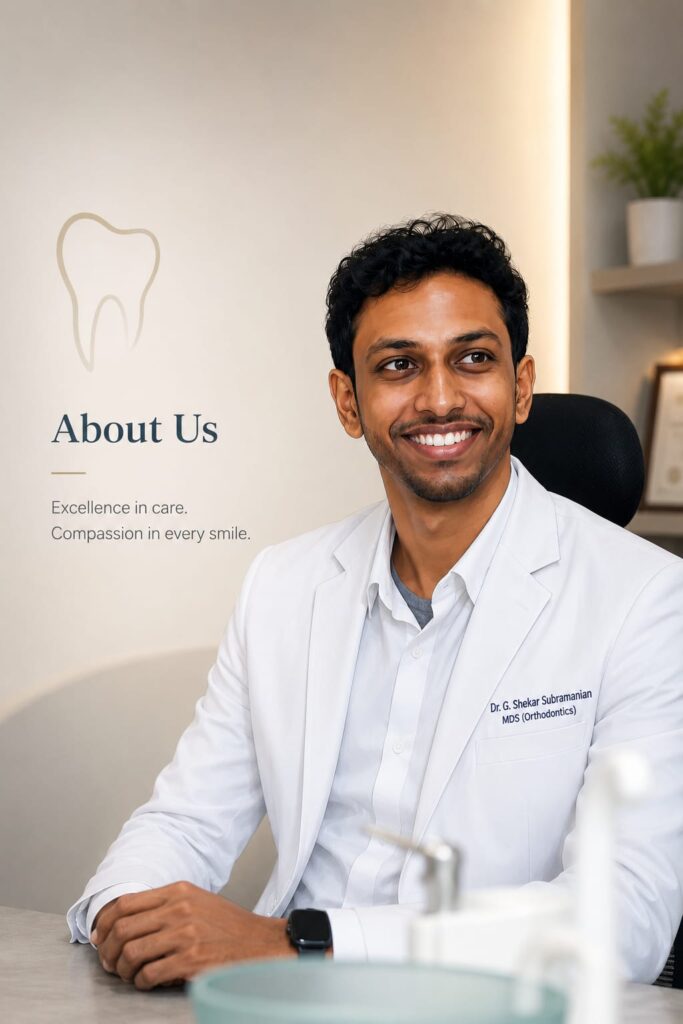
About Us
Elegance Dental Clinic is Rajapalayam’s only orthodontist-owned clinic, delivering precise, evidence-based care.
Get Started
Schedule your consultation to discuss precise orthodontic care tailored for you.